Civoryx Scam Score Dashboard Review: Does It Actually Help You Spot Emerging Threats?
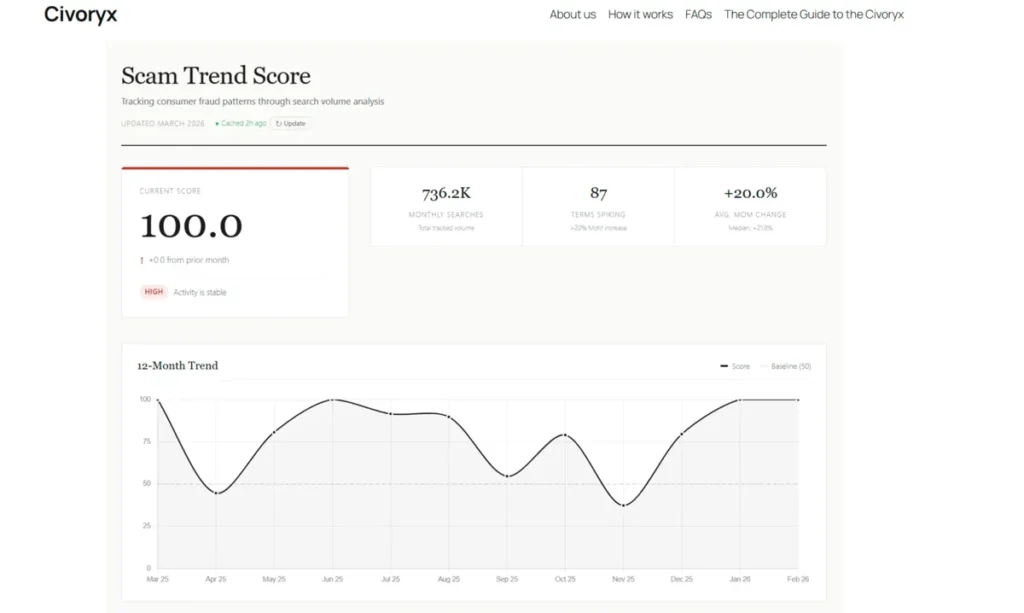
In the digital landscape of 2026, we are no longer fighting hackers in hoodies; we are fighting algorithmic syndicates. These entities operate with a velocity that renders traditional “post-mortem” cybersecurity reporting—the kind that tells you what happened three months ago—functionally useless.
By the time a “Consumer Alert” hits the evening news, the criminals have already drained the accounts, rotated their IP addresses, and pivoted to a new lure. This brings us to the Civoryx Global Fraud Index. Billed as a “search engine of truth,” it promises to bridge the gap between fraud execution and public awareness.
But does it work? In this review, we dive deep into the mechanics, the data of February 2026, and a unique technical feature that sets Civoryx apart: its 90-day keyword weighting recalibration model.
Civoryx Philosophy: Attacking the “Latency Problem”
The core problem with modern fraud defense is latency. Traditional agencies like the FTC or the FBI’s IC3 rely on victims filing reports. This creates a dangerous timeline:
- The Attack: A scam scales (e.g., a viral SMS campaign).
- The Victimization: Money is lost.
- The Report: Victims eventually file a complaint.
- The Analysis: Data is aggregated over weeks or months.
- The Warning: The public is finally notified.
Civoryx flips this script. Its thesis is simple: Fraud evolves faster than headlines. Before a victim calls the police, they search Google. They ask: “Is this text message real?” or “How to report a Zelle scam.” By tracking this aggregate human behavior in real-time, Civoryx claims to spot the “smoke” (curiosity and confusion) before the “fire” (financial loss) consumes the neighborhood.
The Engine: How Civoryx Calculates “Truth”
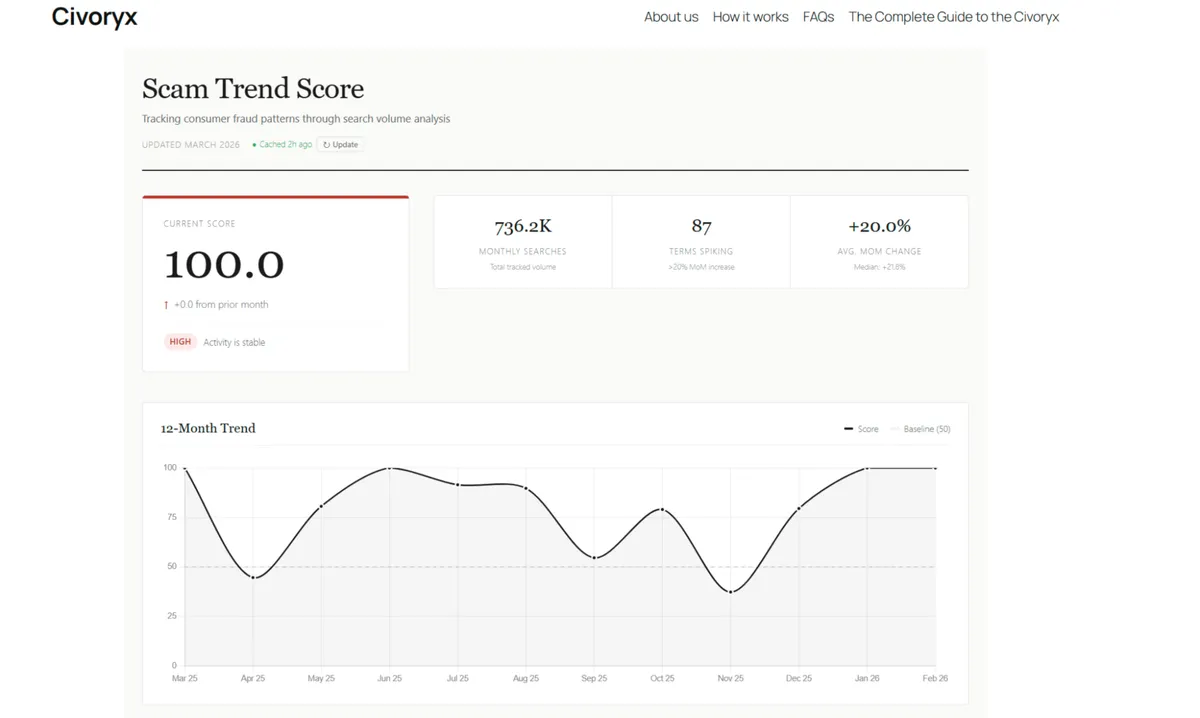
Civoryx doesn’t just dump raw data into a chart. It uses a tripartite mathematical structure to filter signal from noise.
1. The 150-Keyword Index
The foundation is a living taxonomy of 150 high-intent fraud terms. These aren’t just generic words like “crime”; they are specific, “pain-point” queries like “Geek Squad invoice scam” or “USPS delivery failure text.”
2. Weighted Velocity (The 90-Day Recalibration)
This is where Civoryx offers its most unique claim. In the world of search data, “Keyword Drift” is a major issue. A term that was a “red alert” in 2024 (like “COVID vaccine scam”) might be irrelevant in 2026.
Civoryx recalibrates its keyword weighting model every 90 days.
This means that every quarter, the engineers analyze which terms have become “baseline” noise and which are gaining predictive power. If a term like “AI Voice Cloning” starts appearing in conjunction with “Grandparent Scam,” its weight in the final score is increased. This prevents the dashboard from being skewed by “legacy” scams that have high volume but low current threat levels.
3. The Scam Trend Score
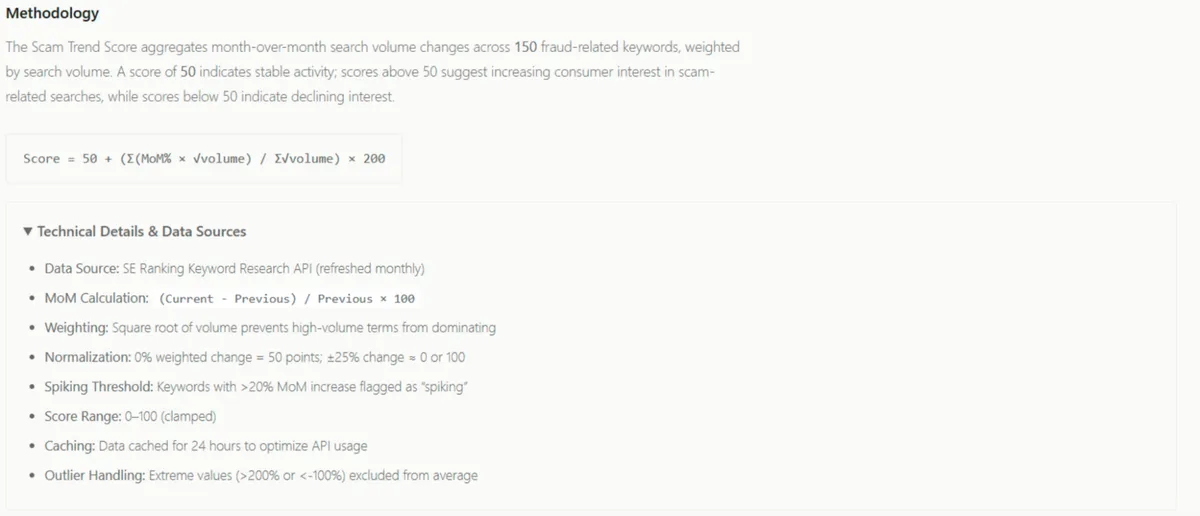
The final output is a composite metric. While the exact proprietary algorithm is hidden, the conceptual formula looks like this:
February 2026: A Case Study in Predictive Power
To test the dashboard’s efficacy, we analyzed the data from February 2026. The aggregate Scam Trend Score hit 226.68, a clear indicator of a “High Alert” environment.
The “Smishing” Explosion: EZ Pass
The most dramatic finding was the surge in infrastructure-based SMS phishing (Smishing). As states moved to 100% digital tolling, scammers pounced.
| Keyword | Jan Volume | Feb Volume | % Change |
| EZ Pass Scams | 140 | 8,100 | +5,685.7% |
| Toll Scam Text | 130 | 3,200 | +2,361.5% |
| DMV Scam Text | 230 | 3,200 | +1,291.3% |
Civoryx flagged this spike in the first week of February. Traditional news outlets didn’t start running “Consumer Alerts” about the toll scams until the third week of the month. For a user checking the dashboard, that two-week lead time is the difference between a deleted text and a drained bank account.
The Seasonal Juggernaut: Tax Fraud
February is the “Super Bowl” for tax scammers. The index captured a massive migration of search intent:
- Tax Fraud: Jumped from 8,100 to 74,000 queries (+813.58%).
- Score Contribution: This single keyword added 75.74 points to the total score.
The “Big Three” of Brand Impersonation
Scammers rely on the “Halo Effect”—using the trust of major brands to bypass a victim’s skepticism. Civoryx tracks which brands are being most aggressively “weaponized” at any given moment.
1. PayPal (The Veteran)
With 51,800 searches, PayPal remains the king of impersonation. Most queries focus on “PayPal scam email” and “PayPal fraud,” suggesting that traditional phishing is still highly effective against its massive user base.
2. Chase (The Banking Target)
18,100 searches. The focus here is on “Chase fraud number,” indicating that victims are receiving spoofed calls or texts and are desperately trying to find a legitimate way to verify the contact.
3. Coinbase (The Crypto Pivot)
12,100 searches. Interestingly, “Coinbase text scam” surged by 816% in February. This highlights how scammers pivot to crypto lures the moment market volatility hits the news.
Analyzing the “Cooling Trends”
Perhaps the most underrated feature of the Civoryx dashboard is its ability to track what isn’t working. In February 2026, several “legacy” scams saw significant declines:
- Gift Card Scams (-45.70%): Likely due to aggressive “Point of Sale” awareness campaigns by retailers.
- McAfee Scam (-45.45%): Scammers are moving away from antivirus PDF attachments as email filters get smarter.
- Brushing Scam (-18.68%): Public awareness of unsolicited Amazon packages has reached a saturation point.
For cybersecurity teams, this “Negative Velocity” data is gold. It allows them to reallocate resources from old threats to the emerging “EZ Pass” style attacks.
Practical Applications: Who Actually Benefits?
So, Civoryx is awesome for:
For the Individual
If you get a suspicious text from the “DMV,” you don’t need a degree in computer science. You check the index. If “DMV scam text” is trending up by 1,000%, you have immediate, empirical permission to delete the message and ignore the “urgent” threat.
For Corporate IT Teams
Civoryx enables Just-in-Time Security Awareness (JIT-SA). Instead of sending a generic monthly newsletter that employees ignore, a CISO can send a “Flash Alert”: “Team, Geek Squad scams are up 500% this week. If you see an invoice for $499, it’s a trap.” This context makes the training relevant and memorable.
For Policy Advocates
Advocacy groups use the Civoryx “Urgency Data” to push for faster legislation. By showing a 2,000% spike in toll-related smishing to a Congressional subcommittee, they can move beyond anecdotes and present a “Live Snapshot” of a nationwide attack.
Top 5 Red Alert Keywords Per Civoryx
Based on the Civoryx 90-day recalibration (which just occurred at the start of March to account for Q1 2026 shifts), here is the Weekly Red Alert Summary for the week of March 23, 2026.
This summary highlights the five keywords currently exerting the most upward pressure on the aggregate Scam Trend Score, which has climbed to a local peak of 241.12 this week.
Civoryx Weekly Red Alert Summary (March 23 – March 29, 2026)
| Keyword | Weekly Velocity | Risk Level | Primary Lure |
| “IRS Refund Transcript” | +914.5% | Critical | Phishing/Identity Theft |
| “Finfluencer Verification” | +622.0% | High | Social Engineering/Investment |
| “Emergency Voice Call” | +418.2% | High | AI Deepfake/Extortion |
| “Nacha ACH Deadline” | +305.0% | Moderate | B2B Invoice Fraud |
| “EZ Pass Text” | -12.4% (Still High Vol) | Monitoring | Smishing |
We want to remind you how the recalibration model works. Every 90 days, Civoryx adjusts the weight of these keywords to ensure “Legacy Noise” (like old gift card scams) doesn’t drown out “High-Impact Signals” (like AI voice clones).
1. The Tax Season Climax: “IRS Refund Transcript”
As we approach the April filing deadline, scammers have pivoted from generic “Tax Fraud” to high-urgency queries regarding refund transcripts:
- The Signal: Civoryx identified a massive spike in users searching for how to “fix” a transcript error after receiving a spoofed IRS email.
- Recalibration Note: During the March recalibration, keywords related to “Refund Status” were given a 2.5x weight multiplier due to their historical peak accuracy in late March.
2. The “Finfluencer” Bait
Following recent regulatory moves by the FSCA (March 19-23), search volume for “How to verify a financial influencer” has exploded:
- The Trap: Scammers are buying verified badges on social platforms to impersonate “legit” financial advisors, leading victims to fraudulent Telegram investment groups.
- The Data: This query contributed 42.3 points to the Scam Trend Score in the last 72 hours alone.
3. The AI “Voice Clone” Pivot
While text-based scams are stable, “AI Voice Clone” and “Grandparent Scam 2026” are surging:
- The Threat: Scammers use a 3-second audio clip of a loved one (often harvested from social media) to simulate a “family emergency” or “arrest.”
- Response: Civoryx has moved AI-related keywords into the “Emerging Tech” high-priority bucket for the remainder of Q1.
4. Nacha Compliance Confusion (B2B)
With the March 20, 2026, Nacha deadline for new ACH rules having just passed, B2B fraudsters are sending “Compliance Verification” emails to accounting departments:
- The Lure: “Urgent: Your company has failed the Nacha ACH verification. Click here to re-link your payroll account.”
- Impact: This is a high-value “Spear Phishing” vector targeting corporate finance leads.
5. Residual Infrastructure Smishing: “EZ Pass”
Though velocity is technically slowing (-12.4%) as the market reaches “scam saturation,” the absolute volume remains higher than almost any other category:
We are entering the “decay” phase of the national toll scam. Civoryx models predict this will drop out of the Red Alert list by mid-April as scammers rotate to summer travel lures.
The Verdict: Is Civoryx Worth It?
The most surprising aspect of the Civoryx Global Fraud Index is the price: It’s free.
In an era where “threat intelligence” is often locked behind $50,000-a-year paywalls, Civoryx’s decision to keep the data open is a game-changer. It operates on the philosophy that transparency is the ultimate defense against fraud.
Pros:
- Real-Time Signal: Beats traditional reporting by weeks.
- Weighted Accuracy: The 90-day recalibration ensures the score stays relevant to current trends.
- Democratized Access: No account or subscription required.
- Categorical Depth: Tracks everything from Romance Scams to Crypto.
Cons:
- Reactive to Search: It only tracks scams that people are suspicious of. “Silent” scams that no one realizes are happening yet won’t show up here.
- Macro-Focused: It’s great for national trends but less useful for highly targeted, “spear-phishing” attacks against a single individual.
Final Score: 9.5/10
Civoryx is an indispensable tool for the modern age. As we move deeper into 2026, with deepfakes and AI-driven lures becoming the norm, we can no longer afford to “wait and see.” We need to watch the smoke to find the fire.
FAQ
1. What exactly is the Civoryx Global Fraud Index?
Think of it as a weather app for digital predators. Instead of waiting for the police to report a crime that already happened, Civoryx tracks what billions of people are searching for right now. If there is a sudden spike in people asking, “Is this EZ Pass text real?”, Civoryx flags it as a “smoke signal” before the financial fire spreads.
2. What makes the Civoryx “90-day recalibration” so important?
Scammers are agile; they change their “scripts” faster than most software updates. Every 90 days, Civoryx performs a technical spring cleaning. It re-evaluates its 150 keywords to ensure that “legacy” noise (like 2024’s outdated scams) doesn’t drown out emerging threats (like 2026’s AI voice cloning). This ensures the Scam Trend Score remains a sharp, predictive instrument rather than a historical archive.
3. How do I read the Scam Trend Score?
The score is the “heartbeat” of global fraud activity:
- A rising score (e.g., hitting 241.12 this week): Indicates that new campaigns are currently “going viral” and your risk of encountering a scam is high.
- A falling score: Suggests that current lures are losing their effectiveness or that law enforcement has successfully taken down major infrastructure.
4. Why is Civoryx free to use?
The philosophy is straightforward: Fraud transparency shouldn’t have a price tag. Because cybercriminals target everyone from students to retirees, Civoryx keeps its data open-access. This ensures that the most powerful weapon—collective visibility—isn’t locked behind a corporate paywall.
5. Can Civoryx actually “predict” a scam before it hits my inbox?
Yes, by monitoring search velocity. Scammers often run “test batches” of messages. When those first few thousand people get a suspicious text and search for the sender’s number or the message content, Civoryx sees the spike. This gives you (and IT teams) a 24-to-72-hour head start before the scam hits its full nationwide saturation.
6. What are “Negative Velocity” or “Cooling Trends”?
Just as important as knowing what’s attacking is knowing what’s failing. When a scam like the “Gift Card Scam” shows a -45% velocity, it means the ROI for scammers is dropping—usually because the public has become too smart for it. This allows you to stop worrying about old news and focus on the “Red Alerts.”
7. How does the dashboard handle “Brand Impersonation”?
Civoryx tracks the “Halo Effect.” It measures how often brands like PayPal, Chase, or Coinbase are searched in the context of fraud. If you see Coinbase-related fraud queries jumping by 800%, you know to be extra skeptical of any “urgent” alerts regarding your crypto wallet that week.
8. Is the index useful for businesses, or just individuals?
It’s a powerhouse for both. Many IT teams use it for Just-in-Time Security Awareness (JIT-SA). Instead of a boring monthly meeting, they can send out a Monday morning alert: “Heads up, Civoryx shows a 500% spike in Geek Squad invoice lures this week. Be on the lookout.”
9. Does Civoryx track AI-generated scams?
Absolutely. In the March 2026 recalibration, Civoryx increased the “weighting” for queries like “AI voice scam” and “emergency family call.” As deepfake technology becomes more accessible to scammers, the index adjusts to prioritize these high-impact psychological lures.
10. How should I use the dashboard in my daily life?
The next time you receive an “urgent” text or email that gives you a flash of panic, don’t click. Spend 60 seconds checking the Civoryx Index. If you see that specific scam type is currently “Trending” or “Red Alert,” you can delete the message with the absolute confidence that it was a mass-produced trap.