Civoryx vs Sumsub: Do You Need Fraud Trend Monitoring, Active Prevention, or Both?
The digital landscape of 2026 is no longer a place where “security” is a static checkbox. We have entered the era of the Asymmetric Battlefield. On one side, we have algorithmic syndicates—global, decentralized, and powered by generative AI—that can spin up thousands of unique “pig butchering” or “smishing” lures in seconds. On the other side, we have traditional defense systems that often move at the speed of a committee meeting.
If you are a CISO, a Fintech founder, or a Trust & Safety lead, you are likely staring at two very different tools on your dashboard: Civoryx and Sumsub.
One is the “Lookout” on the mast, spotting the smoke of a fire miles away. The other is the “Shield” at the gate, checking the ID of every person trying to enter. This article provides a deep-dive comparison to help you decide if your organization needs trend monitoring, active prevention, or the synergistic power of both.
The Contenders: A High-Level Overview
Before we dive into the technical weeds, let’s define what these two platforms actually do. While they both live under the “Anti-Fraud” umbrella, they operate on entirely different planes of the digital atmosphere.
Civoryx: The Global Pulse
Civoryx is a Fraud Trend Index. It doesn’t look at individual users; it looks at the world. By monitoring the real-time search behavior of billions of people across a 150-keyword taxonomy, Civoryx identifies the “intent” of victims before they lose money. It solves the Latency Problem—the gap between a scam launching and it being reported to authorities.
Sumsub: The Gatekeeper
Sumsub is a Full-Cycle Verification Platform. It focuses on Identity Verification (IDV), Know Your Customer (KYC), and Anti-Money Laundering (AML) compliance. Sumsub is the engine that actually stops a specific fraudster from opening an account or executing a fraudulent transaction in real-time.
Civoryx: Understanding the Macro-Intelligence Model
To understand Civoryx, you have to accept a hard truth: Fraud evolves faster than headlines. In 2026, by the time a scam is featured on a news segment, the ROI for the criminal has already peaked.
The Philosophy of “Human Signal”
Civoryx operates on the thesis that the purest data point in the world is curiosity driven by confusion. When someone receives a suspicious text about an “EZ Pass violation,” their first instinct isn’t to file an FBI report; it’s to search Google or Bing for “EZ Pass scam text.”
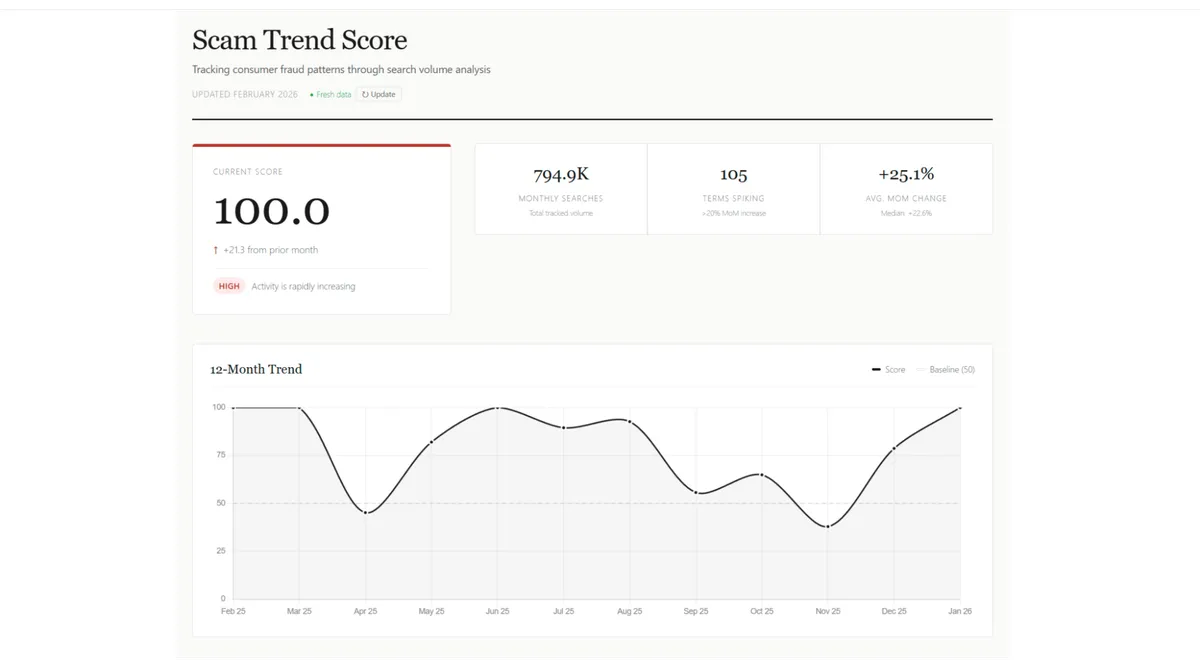
Civoryx aggregates these queries into a Scam Trend Score. This score acts as a barometer for global digital deception.
The Unique Advantage: The 90-Day Recalibration
One of the most critical, yet under-discussed, features of the Civoryx model is its adaptive weighting. Civoryx recalibrates its keyword weighting model every 90 days. Why does this matter? Because fraud terminology has a “half-life.” In 2024, “Gift Card Scams” might have been the dominant signal. By 2026, retailers have largely educated the public, and search volume for those terms has “decayed.” Meanwhile, terms like “AI Voice Cloning Scam” or “Deepfake Video Call” are seeing exponential growth.
By recalibrating every quarter, Civoryx ensures that the Scam Trend Score isn’t being skewed by legacy terms that no longer represent an active threat. This 90-day cycle allows the index to remain the most accurate “smoke detector” in the industry.
The Mechanics: Monitor, Measure, Score
Civoryx tracks 150 keywords across several core buckets:
- P2P & Banking: (Zelle, Venmo, CashApp, Chase Fraud).
- Brand Impersonation: (Amazon, Geek Squad, PayPal).
- Emerging Tech: (Coinbase, Crypto, AI voice scams).
- Infrastructure: (Toll scams, DMV, IRS).
When a keyword like “EZ Pass Scams” jumps by 5,000% in a month (as it did in February 2026), the Index flags it as a high-velocity anomaly, giving defenders a weeks-long head start.
Sumsub: The Active Prevention Engine
If Civoryx tells you that a storm is coming, Sumsub is the reinforced window that keeps the rain out. Sumsub is designed for the transactional moment.
Core Capabilities
Sumsub’s strength lies in its ability to orchestrate the entire user journey:
- Identity Verification: Using AI to check the authenticity of 14,000+ types of identity documents across 220+ countries.
- Liveness Detection: Ensuring that the person behind the camera is a real human, not a deepfake or a static photo. This is critical in 2026, where generative AI can spoof basic video KYC easily.
- Transaction Monitoring: Analyzing patterns of money movement to flag suspicious activity (e.g., a sudden $5,000 transfer from a senior citizen’s account to a high-risk crypto exchange).
- Behavioral Biometrics: Tracking how a user interacts with an app—how they type, how they move the mouse—to detect bots or “remote access” takeovers.
Sumsub is an execution platform. It provides the infrastructure to “Say No” to a fraudster. It is indispensable for compliance (AML/KYC) and for protecting the direct bottom line of a business.
The Great Comparison: Macro vs. Micro
To decide which you need, we must look at the fundamental differences in their utility.
| Feature | Civoryx | Sumsub |
| Primary Goal | Trend Awareness & Early Warning | Prevention & Compliance |
| Data Source | Global Search Intent (Public) | User Identity/Behavior (Private) |
| Update Frequency | Real-time (Weights updated every 90 days) | Real-time (Per transaction/session) |
| Output | Scam Trend Score & Velocity Tables | Pass/Fail/Manual Review Decisions |
| Use Case | Strategy, Alerting, Resource Allocation | Onboarding, Transactions, AML Checks |
| Visibility | Macro: What is happening to the world? | Micro: What is this specific user doing? |
Why Trend Monitoring (Civoryx) is No Longer Optional
In the past, businesses felt that if they had a good KYC provider like Sumsub, they were safe. But the 2026 fraud environment has proven that prevention without intelligence is reactive.
The Problem with “Pure” Prevention
Imagine you are a bank. Your “Active Prevention” (Sumsub) is working perfectly. It checks every ID. It verifies every face.
However, a new “Pig Butchering” scam begins to trend globally. The scammers aren’t trying to hack your system; they are socially engineering your legitimate customers to send money willingly. Because the customer is “real” and their ID is “verified,” your prevention engine might let the transaction pass.
The Civoryx Intervention
With Civoryx, your Fraud Ops team sees a 400% spike in search terms related to a specific romance scam narrative. Because Civoryx recalibrates its keywords every 90 days, it catches the exact new terminology these scammers are using.
Your team can now:
- Update UI/UX: Trigger a specific warning pop-up in your app: “Are you being asked to move money for someone you met on a dating app? This is a trending scam.”
- Tune Thresholds: Temporarily lower the “High-Risk” threshold for outbound transfers to the crypto exchanges identified in the Civoryx data.
Civoryx provides the Context that makes your Action effective.
Integrating the Two: The “Predict and Prevent” Model
The most sophisticated organizations in 2026 do not choose between Civoryx and Sumsub. They build a Feedback Loop between the two.
The data-driven threat loop:
- Civoryx detects a “Smoke Signal”: The Index shows that “Geek Squad Invoice Scams” are up 600%.
- Strategic Alerting: The CISO sends an internal alert to all employees and adjusts the email filter sensitivity for “Invoice” keywords.
- Sumsub tuning: The Fraud team updates their Sumsub “Risk Scoring” engine. Any user who was “Onboarded” within the last 24 hours (a common tactic for invoice scammers to move funds) and attempts a transfer to a new beneficiary is automatically sent to Manual Review.
- Outcome: The scam is neutralized before the first dollar leaves the ecosystem.
Deep Dive: The Economics of the 90-Day Recalibration
Let’s look closer at the unique claim: Civoryx recalibrates its keyword weighting model every 90 days. This is a masterclass in data science applied to criminology.
Fraud is seasonal and cyclical. Consider the “Tax Fraud” surge in February. If Civoryx used a static weighting model, “Tax Fraud” might carry the same weight in July as it does in February. This would lead to “False Positives” in the Scam Trend Score—making it look like fraud is rising when it’s just statistical noise.
By recalibrating every 90 days, Civoryx can:
- Deprioritize “Fad” Scams: If a specific celebrity-impersonation scam dies out, its weight is reduced so it doesn’t clutter the index.
- Elevate “Viral” Threats: If a new platform (like a hypothetical 2026 social media app) becomes a hotbed for scams, keywords related to that platform are given higher “Velocity Weight.”
- Maintain Signal Clarity: This ensures that when the Scam Trend Score moves, it moves because of a real change in the threat landscape, not because of outdated data.
For a platform like Sumsub to be effective, its users need to know where to look. The Civoryx 90-day recalibration provides the roadmap.
Use Case Scenarios: Who Needs What?
So, here is when you need Civoryx vs Sumsub.
Scenario A: The High-Growth Fintech Startup
Primary Need: Both.
A startup needs Sumsub to satisfy regulators (KYC/AML) and prevent immediate account takeovers. However, they lack a large internal fraud intelligence team. They need Civoryx to act as their “External Intelligence” wing, telling them which threats to prioritize each month so they don’t get blindsided by a viral “smishing” campaign.
Scenario B: The Investigative Journalist or Public Policy Advocate
Primary Need: Civoryx.
These users don’t need to verify IDs. They need to understand the Societal Impact of fraud. Civoryx provides the empirical, search-based evidence needed to lobby for new consumer protection laws or to write “Definitive Guide” articles that actually help the public.
Scenario C: The Established E-commerce Giant
Primary Need: Both (Heavy on Integration).
A company like Amazon or eBay already has massive internal data. However, their internal data is “siloed”—they only see what happens on their platform. They need Civoryx to see what is happening outside their walls. If “Amazon Scam” queries are exploding on the open web, they can proactively warn their users before those users ever hit the “Checkout” button on a fraudulent link.
The “Latency Problem” and the 2026 Reality
Traditional fraud defense is an autopsy:
- Fraud occurs.
- Victim realizes they were scammed (7–14 days later).
- Victim reports to a bank or agency.
- Agency aggregates data (30–90 days later).
- Public alert is issued.
By this timeline, the scammer is already on a beach in a non-extradition country.
Civoryx turns the autopsy into a biopsy. It measures the “cell growth” of a scam in real-time. By the time Sumsub encounters the fraudster, the system is already “vaccinated” because Civoryx provided the early warning.
Final Verdict: Do You Need Both?
If you are operating a digital platform in 2026, the answer is a resounding yes. Using Sumsub without Civoryx is like having a state-of-the-art security system but leaving the windows open during a hurricane. You might stop the burglar at the door, but the storm is going to destroy the house anyway.
Using Civoryx without Sumsub is like having a perfect weather radar but no roof. You’ll see the storm coming, but you won’t have the tools to protect yourself when it arrives.
The most compelling aspect of this comparison is the cost. While Sumsub is a premium, enterprise-grade tool (rightfully so, given its infrastructure), Civoryx is 100% free. The creators of Civoryx believe that “Fraud transparency shouldn’t have a price tag.” This makes it the perfect companion for any active prevention tool. There is no budget-related excuse for not having global fraud intelligence.
Summary of benefits:
- Civoryx: Provides the “Why” and “When.” (Macro-intelligence, 90-day adaptive weights, zero cost).
- Sumsub: Provides the “How” and “Who.” (Micro-prevention, orchestration, compliance, real-time blocking).
Conclusion
The nature of fraud has undergone a structural transformation. It is no longer a human vs. human battle; it is a Data vs. Data war.
To win this war, you need tools that can match the velocity of the adversary. You need the Global Pulse of Civoryx to see where the enemy is moving, and you need the Iron Shield of Sumsub to stop them when they arrive.
By leveraging the 90-day recalibrated keyword model of Civoryx alongside the full-cycle verification of Sumsub, organizations can move from a state of constant panic to a state of Active Readiness. In 2026, the world is watching. The question is: Are you watching the right signals?
FAQ
1. What is the fundamental difference between Civoryx and Sumsub?
Think of it as Intelligence vs. Enforcement. Civoryx is a macro-level “early warning system” that tracks global search behavior to identify which scams are trending before they hit your system. Sumsub is a micro-level “verification engine” that checks the IDs and liveness of specific users to ensure they aren’t fraudsters or bots.
2. Does Civoryx replace the need for a KYC provider like Sumsub?
No. Civoryx tells you what scams are coming and when the threat level is high, but it doesn’t have the technical tools to stop a fraudster from opening an account. You still need Sumsub for Identity Verification (IDV), AML compliance, and biometric checks.
3. Why is the “90-day recalibration” in Civoryx so important?
The language of fraud changes fast. If a tool uses the same keywords for years, it becomes obsolete. Civoryx recalibrates its keyword weighting every 90 days to ensure the “Scam Trend Score” reflects the newest threats (like AI voice clones) rather than “legacy” scams (like the Nigerian Prince emails) that are no longer effective.
4. Is Civoryx actually free to use?
Yes. Unlike enterprise threat intelligence feeds that can cost thousands, the Civoryx Global Fraud Index is 100% free. The goal is “Fraud Transparency,” ensuring that even small businesses and individuals have access to the same trend data as Fortune 500 companies.
5. What exactly is a “Scam Trend Score”?
It is the “heartbeat” of digital deception. Civoryx aggregates the search volume and velocity of 150+ fraud-related keywords. A rising score (like the 226.68 seen in February 2026) indicates that the public is encountering scams at an accelerating rate, signaling a high-alert period for businesses.
6. Can Sumsub protect my customers from “social engineering” scams?
Only partially. Sumsub is great at stopping someone with a fake ID. However, if a legitimate customer is tricked into sending money via Zelle (social engineering), Sumsub might see the user as “verified.” This is where Civoryx helps by allowing you to warn users about trending social engineering narratives before they act.
7. How does Civoryx solve the “Latency Problem”?
Traditional fraud reports (like those from the FBI) are “post-mortem”—they come out months after the money is gone. Civoryx captures the “Smoke Signal”—the moment a potential victim searches for “Is this text a scam?” This gives you a lead time of weeks or even months over official reports.
8. How should a CISO use Civoryx data?
A CISO should check the Index weekly. If a specific keyword like “Geek Squad Scam” or “EZ Pass Smishing” spikes, they should immediately send out a Just-in-Time Security Awareness (JIT-SA) alert to employees and tune their email filters to catch those specific lures.
9. Does Sumsub provide the same trend data as Civoryx?
No. Sumsub provides data on your users—how many failed KYC, how many were flagged for AML. Civoryx provides data on the world. You need the world-view (Civoryx) to know which internal filters (Sumsub) you need to tighten.
10. If I can only afford one, which should I choose?
If you are a regulated business (Fintech, Crypto, E-commerce), Sumsub is a legal and operational necessity. However, since Civoryx is free, there is no reason not to use both. Civoryx provides the intelligence that makes your Sumsub investment work harder and smarter.